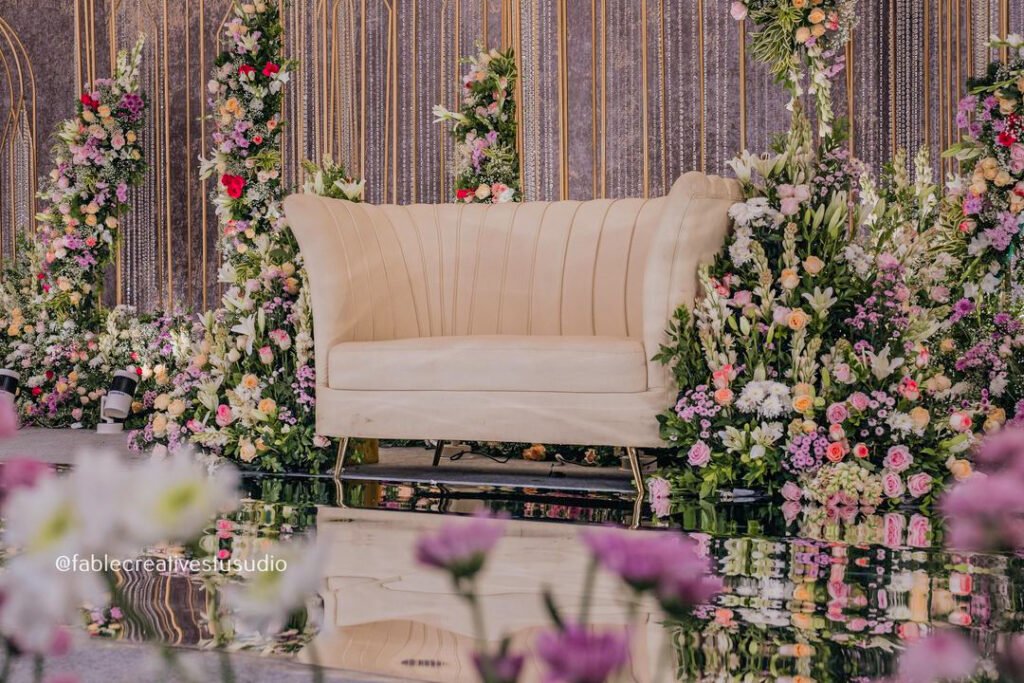
Mehndi Decoration
Mehndi is one of the most colorful and eagerly anticipated events in a Pakistani wedding. It’s the ceremony where henna is applied to the bride, and it typically brings together family and friends for music, dance, and celebration in a setting that’s bright, festive, and full of energy. The decoration for Mehndi is usually the most vibrant of all the pre-wedding events, built around rich traditional colors and abundant floral work.
Professional Mehndi decoration means creating a space that captures this festive spirit while remaining well-planned and coordinated. The decoration should reflect the couple’s chosen colors and theme, work with the venue’s actual size and layout, and give guests a comfortable space to celebrate. Mehndi decoration is not just about adding color everywhere — it’s about creating a coordinated, intentional design that feels joyful without becoming visually overwhelming.
What Mehndi Decoration Includes
A complete Mehndi decoration service typically covers several areas of the venue:
Main Stage or Sitting Area
Most Mehndi events have a designated area where the bride sits, often decorated as the visual centerpiece of the celebration. This might be a raised stage, a decorated swing (jhoola), or simply a styled seating area with a backdrop. Whatever form it takes, this is where most of the decorative attention is focused, and it usually becomes the main photo point for guests.
Entrance and Welcome Area
The entrance sets the tone the moment guests arrive. Mehndi entrances are typically bright and welcoming, often using floral arrangements, colorful fabric, or a decorated arch that hints at the palette and theme used throughout the rest of the venue.
Guest Seating and Venue Styling
Mehndi events usually bring together a large group of family and friends, so guest seating and overall venue coordination matter. Table styling, seating arrangement, and any wall or ceiling decoration should work together with the main stage design rather than feel like separate, disconnected elements.
Floral and Decorative Elements
Flowers play a big role in Mehndi decoration, often used generously to create the festive, colorful look the event is known for. Fresh or artificial flowers can both be used depending on preference, budget, and how long the celebration will run.
Mehndi Stage and Backdrop Design
The stage or main sitting area is the visual anchor of Mehndi decoration, and its design sets the tone for everything else in the venue.
Color and Visual Energy
Mehndi decoration is known for its vibrant color palette. Traditional choices include yellow, green, and orange — often inspired by marigold flowers — though many couples now build their Mehndi around the wedding’s overall colors instead, using brighter, more saturated versions of those same tones. Whatever the palette, Mehndi decoration usually leans toward bold, energetic color combinations rather than muted or restrained ones.
The Jhoola or Decorated Swing
A popular choice for Mehndi stages in Pakistan is a decorated swing (jhoola), often covered in flowers and fabric, used as the bride’s seating area instead of a fixed stage chair. This works particularly well when the venue has the ceiling height and structural support to hang it safely. Not every venue is suited to this, so it’s worth discussing during planning whether a swing or a more traditional backdrop-and-seating setup fits the space better.
Backdrop and Floral Work
Backdrops for Mehndi are often built using a combination of fabric and dense floral arrangements, sometimes with hanging floral strings or garlands layered in front of a colorful fabric base. Because Mehndi decoration tends to be more abundant than some other pre-wedding events, the backdrop often uses more flowers and more layering than a simpler design would.
The backdrop size should still match the venue — a large, heavily layered design can overwhelm a small space, while a modest design can look underwhelming in a large hall. The stage should also be positioned so guests seated throughout the venue have a clear view.
Entrance and Venue Styling for Mehndi
Welcoming Guests
The Mehndi entrance is usually one of the more playful and colorful parts of the decoration. Floral arches, hanging garlands, or a decorated frame at the entry point immediately signal the festive mood of the event. The entrance decoration should be proportional to the walkway so it welcomes guests without slowing down movement into the venue.
Coordinating the Wider Venue
Beyond the entrance and stage, Mehndi decoration often extends to table styling, seating area coordination, and hanging or ceiling elements if the venue allows it. The goal is visual continuity — the same colors and design language used at the stage should show up in smaller ways throughout the rest of the space, so the venue feels like one coordinated event rather than a decorated stage in an otherwise plain room.
Floral Decoration for Mehndi
Abundant, Colorful Arrangements
Flowers are central to Mehndi decoration, and the style tends toward fullness and color rather than minimalism. Marigolds, roses, and other brightly colored flowers are commonly used, either as the main backdrop material or as accents layered over fabric.
Fresh or Artificial Flowers
Fresh flowers bring natural color and fragrance, which suits the festive feel of Mehndi well, though they need to be arranged close to the event and handled carefully if the celebration runs for several hours. Artificial flowers hold their color and shape throughout a long event with dancing and movement, and they allow more flexibility if a specific shade isn’t easily available fresh.
Many Mehndi decorations use a mix — fresh flowers concentrated at the stage where they’ll be seen most closely, with artificial flowers used more broadly to build volume and color throughout the rest of the backdrop and venue.
Color Coordination
Whatever flowers are chosen, their colors should tie back to the overall Mehndi palette. If the theme is yellow and green, the floral work should reinforce that rather than introduce unrelated colors that make the space feel disjointed.
Traditional and Modern Mehndi Styling
Traditional Pakistani and Desi Mehndi Decoration
Traditional Mehndi decoration leans into bold, saturated colors — yellows, oranges, greens, and pinks — combined with generous floral work and layered fabric. The overall look is rich and festive, often with multiple decorative elements layered together rather than a single simple design.
Modern Mehndi Decoration
Modern Mehndi styling tends to simplify the palette, sometimes using two or three coordinated colors rather than a wide traditional spread, and relying more on clean backdrop design with strategic floral placement rather than dense coverage. Pastels, or a single bold color paired with neutrals, are common in more contemporary Mehndi designs.
Choosing a Direction
Neither approach is inherently better — it depends on the couple’s taste, the venue, and how the Mehndi fits into the rest of the wedding’s overall styling. Some couples want the Mehndi to stand out as the most colorful event of the wedding, while others prefer it to feel like a lighter, more relaxed version of the same palette used throughout the celebration.
Planning Your Mehndi Decoration
Understanding the Event
Planning starts with understanding what the couple wants the Mehndi to feel like — bright and traditional, more restrained and modern, or somewhere in between. Their color preferences and any specific ideas they have, such as a swing, a particular floral style, or a themed backdrop, shape everything that follows.
Venue Assessment
The decorator needs to understand the venue’s dimensions, ceiling height, available wall space, and layout before finalizing a design. Ceiling height matters in particular if a decorated swing or hanging floral elements are part of the plan, since these need adequate structural support and clearance.
Information Worth Sharing
To plan Mehndi decoration accurately, it helps to know:
- Event date and expected guest count
- Venue location and size
- Preferred colors or a general palette direction
- Whether a stage, swing, or seated backdrop is preferred
- Fresh, artificial, or combined floral preference
- Traditional or modern styling preference
- Any specific themes or ideas already in mind
The more detail shared upfront, the more accurately the design can be planned and quoted.
Customization
Every Mehndi is different, and the decoration should reflect that. Customization might mean adjusting the color intensity, choosing between a swing and a fixed stage, deciding how much of the venue beyond the stage gets decorated, and selecting a floral style that matches the couple’s taste rather than a generic template.
Factors That Affect Mehndi Decoration
Several practical factors shape how a Mehndi decoration is planned and what it involves:
- Venue size and ceiling height — affects stage scale and whether hanging elements or a swing are practical
- Guest count — influences how much of the venue needs seating and decoration coordination
- Floral density and choice — denser, more layered floral work takes more materials and setup time than a simpler design
- Fresh vs. artificial flowers — affects both cost and how close to the event the setup can happen
- Design complexity — a swing with multiple floral layers takes longer to install than a simple backdrop
- Venue conditions — indoor venues with stable walls and ceilings differ from outdoor or semi-outdoor spaces in terms of what’s structurally possible
Prices and packages aren’t something we list here, since every Mehndi is different, but these are the practical factors that shape what a specific setup will involve.
Mehndi Decoration Setup
Setup for Mehndi decoration usually involves assessing the venue in advance, preparing the fabric, floral, and structural elements beforehand, and then installing everything on site — starting with any structural pieces like a stage or swing frame, followed by fabric and floral work, and finishing with entrance and secondary area decoration. Timing depends on how elaborate the design is; a simpler backdrop and entrance can be ready in a few hours, while a fuller design with a decorated swing and dense floral work across the venue takes longer.
Frequently Asked Questions
What makes Mehndi decoration different from Dholki or Mayon decoration?
Mehndi is generally the most colorful and floral-heavy of the pre-wedding events, often built around the traditional yellow-green-orange palette or a bright version of the wedding colors. Dholki tends to center more around the music and dancing space, while Mayon has its own distinct pre-wedding character. Each is planned with its own color approach and focal design.
Can we have a decorated swing for the Mehndi stage?
Yes, where the venue’s ceiling height and structural support allow it. A decorated swing is a popular choice for Mehndi, but it needs to be assessed against the specific venue before confirming it as the design direction.
Should we use fresh or artificial flowers for Mehndi?
Both work well. Fresh flowers give natural color and fragrance but need to be arranged close to the event. Artificial flowers hold their color and shape through a long, lively celebration. Many Mehndi setups combine both.
Can the decoration be adjusted to fit a smaller venue?
Yes. A smaller venue simply calls for a more proportionally scaled stage and floral design rather than a smaller version of everything. The goal is a design that fits the space comfortably rather than crowding it.
How far in advance should we plan Mehndi decoration?
A few weeks’ notice is usually enough for planning and discussion, though more elaborate designs — particularly ones involving a swing or extensive floral work — benefit from earlier planning.
Planning Your Mehndi Celebration
Mehndi decoration should capture the color and energy this event is known for, while still feeling coordinated and intentional rather than overdone. From the stage or swing to the entrance, floral work, and overall venue styling, the decoration should reflect the couple’s chosen palette and create a space that’s ready for a full evening of celebration.
If you’re planning a Mehndi in Pakistan and want to discuss decoration, share your event date, venue, available space, preferred colors, whether you’re drawn to a stage or a decorated swing, your floral preference, and any specific ideas you already have. With these details, we can put together a Mehndi decoration plan that fits your venue and matches the festive spirit of the event.